

TURKMENISTAN – AN EXAMPLE OF STRATEGIC SOLUTIONS IN THE FIELD OF "GREEN" ENERGY
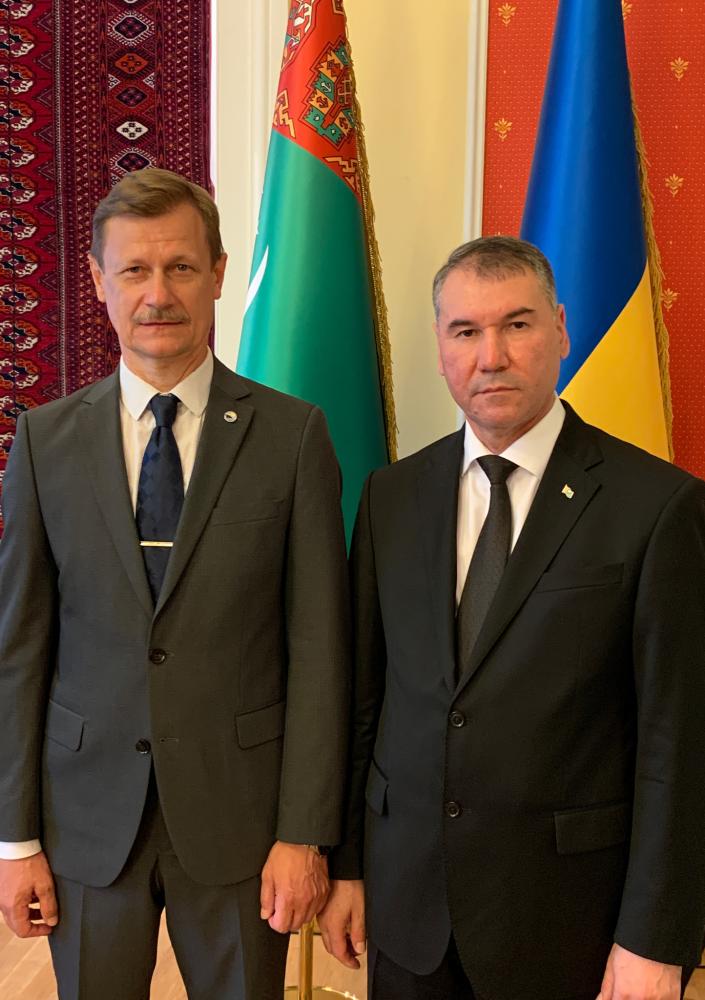
Today, a working meeting was held between Volodymyr Makukha, Chairman of the Board of the Baltic-Black Sea Economic Forum (Baltic-Black Sea-Caspian Forum), and Toyly Atayev, Ambassador Extraordinary and Plenipotentiary of Turkmenistan to Ukraine.
Turkmenistan is an example of strategically sound, effective solutions aimed, among other things, at the development of the entire Central Asian region.
In addition to joint projects related to the development of optimal transport and logistics routes, where the modern international seaport of Turkmenbashi plays a key role in the region, a number of strategic issues in other equally important sectors were discussed.
Considering that the Baltic-Black Sea Economic Forum (Baltic-Black Sea-Caspian Forum) is one of the communication platforms whose mission is to promote effective cooperation from the Baltic Sea countries to the Caspian Sea basin and Central Asia, attention was focused on projects that had been jointly implemented by the forum team in the Republic of Lithuania and aligned with the strategic development programs adopted in Turkmenistan.
Among these important projects, projects related to the introduction of renewable energy were identified.
The issue of ecology and the development of "green" (renewable) energy is one of the priorities of Turkmenistan's state policy.
As Toyly Amanmuhammedovich noted, back in 2020, then-President of Turkmenistan Gurbanguly Berdimuhamedov created an interdepartmental working group to develop a National Strategy for the Development of Renewable Energy. Just one year later, on March 3, 2021, the Renewable Energy Development Strategy until 2030 was approved with the support of UNDP as part of a joint project between the United Nations Development Programme (UNDP) and the Ministry of Agriculture and Environmental Protection of Turkmenistan.
This demonstrates both the high quality of the document itself and its strategic importance.
The Ambassador also noted that in 2021, Turkmenistan adopted the Law "On Renewable Energy Sources," which provides for state support for relevant projects in this area and stimulates investment.
President Serdar Berdimuhamedov and the Government of Turkmenistan are also paying special attention to the implementation of the country's updated climate strategy, which includes expanding the use of renewable energy, improving energy efficiency, and reducing methane emissions in the gas sector.
It was also noted that the Government of Turkmenistan is implementing energy conservation programs and supporting research centers focused on solar and wind energy.
In this context, the developments that formed the basis for the memorandum signed on June 4, 2026, during the Lithuania-Ukraine videoconference between the Baltic-Black Sea Economic Forum (Baltic-Black Sea-Caspian Forum) and the Lithuanian Confederation of Industrialists on the development of Global BOD Group and the reputable Ukrainian holding company OKS UA are of particular interest.
As Volodymyr Makukha, Chairman of the Forum's Board, noted during the meeting, the Lithuanian holding company Global BOD Group, which includes the world-renowned solar panel and solar energy equipment manufacturer SoliTek, has developed innovative developments that are worthy of consideration for their potential use in Turkmenistan.
In particular, SoliTek has a separate line of BIPV (Building Integrated Photovoltaics) solutions for facades and roofs. These are integrated solar modules (SOLRIF series), which replace roofing material, effectively serving as both a roof and a solar power plant. SOLID are frameless BIPV modules for façade integration (used as ventilated façades, building cladding, and architectural BIPV solutions).
It's worth noting that these developments by Lithuanian partners could be very relevant for Turkmenistan, which averages up to 300 sunny days per year.
Specifically, the façade panels:
- work even where the roof is occupied by equipment;
- vertical modules accumulate less dust and sand, which is important in arid climates;
- light or white BIPV façade panels can complement the stunning white marble architecture of Ashgabat and other cities in Turkmenistan.
